TWINEXUS: Digital Twins for Nexus-based Decision Analysis in Urban Planning
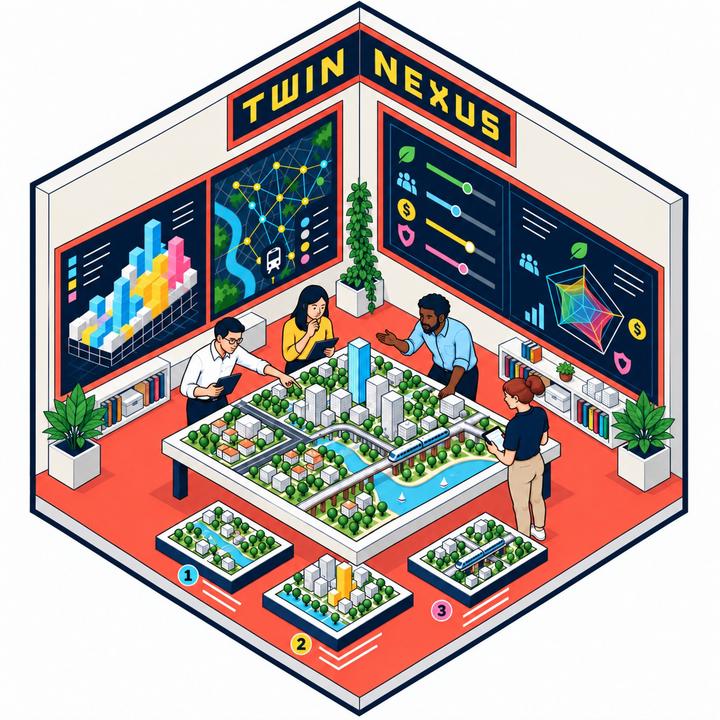
Instructors: Dr. Pirouz Nourian (coordinator) and Dr. Mafalda Madureira
Challange:
Planning decisions rarely stay inside the sector they are made in. A road relieves congestion but induces demand and restructures land values; a flood barrier protects one zone but redirects risk to another; a solar farm alters urban heat, which alters cooling demand. These feedback loops are the nexus the course is named after: a property of the urban and environmental system itself, not of any modelling toolchain. A digital twin is useful here only insofar as it makes such trade-offs quantifiable and communicable to the actors who must decide between them. It does not replace planning judgment; it augments it, by making the consequences of a choice visible before that choice is committed to. In TWINEXUS you specify, assemble, and demonstrate a Planning Support System (PSS) for an environmental planning problem of your own choosing, and you defend it orally: the system must make a trade-off visible and defensible, not issue a verdict. The backbone: five layers, five lectures:
The course deliberately carries a lean conceptual backbone and moves to the studio fast. Each lecture covers one layer of the TWIN-NEXUS architecture; each layer produces one formal object that the next layer consumes. Discretization is a methodological commitment, not a preprocessing step. The choice of grid encodes assumptions about resolution, area equivalence, and neighbourhood topology that propagate through every downstream computation; it is also what turns a vague “planning measure” into a measurable decision variable, and what makes the decision space finite, enumerable, and, if you like, playable.