Zhuoran Jia
Former PhD Candidate at TU Delft, Faculty of Architecture|Postdoctoral Researcher @ South China University of Technology
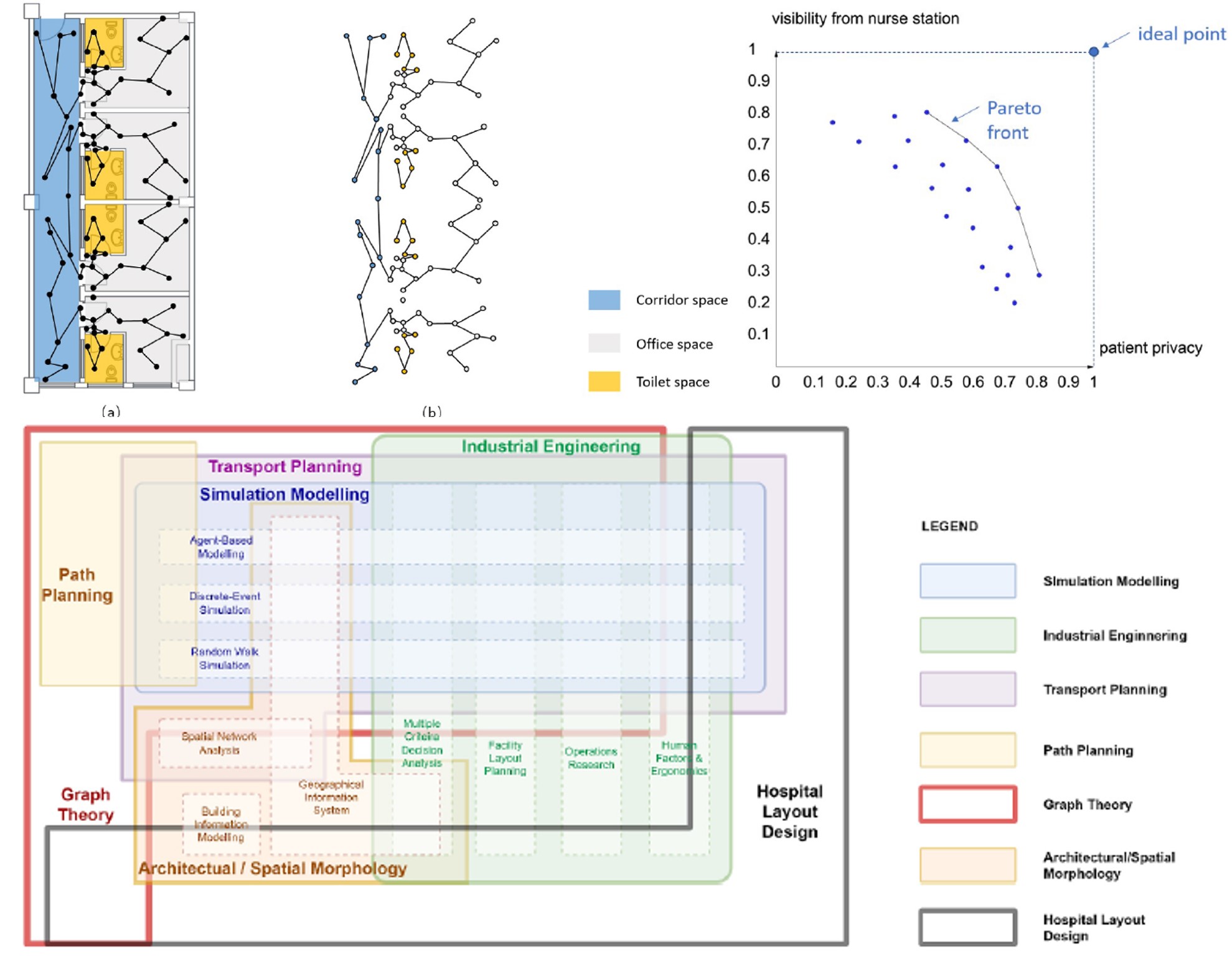
The work first introduces the Hospital Configuration Model (HCM), a structured dataset capturing geometric, topological, semantic, and operational information about a hospital layout, which serves as the foundation for the HDSS. Building on the HCM, the HDSS combines three core models: a Four-Step Transportation Model simulating the hospital’s city-like circulation to assess overcrowding, walking distances, and wayfinding difficulty; a Discrete-Event Simulation Model capturing the hospital’s factory-like operations to evaluate patient waiting times; and an Exploratory Network Analysis Model examining the underlying spatial logic of hospital layouts independent of specific functions. Results from these models are aggregated and normalized into a common functional unit, enabling fair comparison across hospitals of different scales, and giving architects, hospital administrators, and head nurses a robust tool for evaluating layout alternatives during early design stages.